Sunday, January 16, 2011

Steps to English vocabulary

Speak fluent English, you should know that the vocabulary available. All students in English knows, but the problem is not the right method to use to learn vocabulary, most students a dictionary and start memorizing random words that no sense!
I have written these few simple steps for you.
If you learn more words in a short period of time:
1) Choose a topic:
It is the first step you select the theme you want to learn the vocabulary, for example, you can eat, transportation to choose ... This is very powerful, because every time you have an English word, you will not forget all the other words that you found her.
I suggest that you choose a topic you need from his vocabulary, for example if you are an entrepreneur, you can choose a theme related to the company ...

2) Use photos, remember English words more quickly:
The idea of the images is an old idea, but it still works.
It is also used by native speakers of children.
I already talked about children learning English and this article offers some tips to speak English and also in many others.
Steps to English vocabulary
 
3) Write sentences in English:
In general we talk about writing new words of English, but I'm talking about writing sentences in English that contains new words of English. If you're a new word, write the whole sentence, it is in English, many students have a huge vocabulary in their minds, but they do not know how to use basic vocabulary, because they just write lists of words in their specifications.
So you need to write sentences in English for two things in one.

4) Take-related English words:
What does this mean? and that means that when you find a new word, try using groups of words that accompany it too. It is also called tag trees. For example, if your word is the hotel, you can add "room, bed .
It is very easy if you've chosen a theme that I said.

5) English words with the same root:
This is very powerful and very simple, but you can skip this step if you do not know if you can not find the words.
It is to find other English words that have the same root (noun, adjective, verb, ...) have
For example: travel -> Travel - Travel -> ...

6) Use new words in English:
If you think you sentences with new words in your notebook is enough, you're all wrong!
You must use the new words you found, you should practice with your friends in English (this is the best way to practice English: speaking English with native speakers)

7) Review New English vocabulary at all times:
If you have not reviewed the new vocabulary you've learned is the same as if you did nothing!
The exam is so important, learning method consists of: understanding, learning, revised. If you are one of them will be a big problem (maybe you never speak English as you do!)


Never Learn Grammar Rules

In fact, by studying the grammar to make it harder for you to talk, because once you speak, you think of grammar rules and it makes you very angry, and you learn not to speak unless your sentence is correct , and that is the biggest mistake students make!
Study of grammar is very dangerous right way to teach grammar to a method where you learn to choose, without studying, because if you study, you never learn!
I will talk about some good methods you can do to learn grammar easily and without the study:
Never Learn Grammar Rules

First
If you are studying grammar, stop doing, and wait about 2-3 weeks before you start leaning to the right method.If you participate in an English school, you should immediately stop or an appointment with your school. Before we begin, I ask you a question: what kind of books do you read?
Think about it within seconds or minutes to read.
It easier for you to answer, I'll give you a few choice grammar, stories, novels, children's books, vocabulary books, newspapers ... etc.
If your answer is this one: grammar, vocabulary books, my advice for you to sell to another person or to throw over the window.
If you answered newspaper: my advice to you is to keep them away from you for a while (at least 6 months)
If your answer novels, stories for children: my advice is to read, they're great!
Now I will explain in more detail the situation:
Grammar and vocabulary books are now your enemy, you must learn to hate them as soon as possible, they both teach you English do not speak English, and they are useless!
They spend so much time, without any improvement, and they are also educational materials, so they are not good! You must learn to hate them.
Stay away, do not keep in your home, and never open a book of grammar or vocabulary book ever!
Grammar learns to think in English, and vocabulary books tell you memorize word lists, and you can not do that!
In a real conversation (not a review or an e-mail or postal mail, etc ...) you have time to think about grammar or did not remember the words so you need to learn a powerful method!
Newspapers are good, but they are too difficult for you now, use your dictionary more than once as you read, it is also difficult for native speakers to keep them away from you until you learn basic vocabulary, and speak without thinking and grammar, without studying.
Finally, the novels and stories are best for you now, they're easy to read, so you do not need a dictionary, even if there are words that do not now feel you understand without the help of a dictionary and this helps you deeper into your brains!
Although both novels and short stories are ideal for learning without study, I recommend many novels Reasons:
The first reason is because they are long, yes, you read a difficult word more than once, and it's a powerful way to learn vocabulary without having to remember if you do not understand a word just relax and continue reading without opening your dictionary, maybe the next time you'll understand.
Seeing the same word in different phrases you get deeper in the brains, without the need for a dictionary that is very powerful!
Only because the novels are long, you become more familiar with the writer, because everyone has the words and repeat them. (Ex: read my articles and you will see that I have a few words, I repeat a lot, if you read many of my articles, you get me 100%)
If you like novels you read, you will not feel that you are a student, you should choose the novels before you start reading.
Furthermore, in one of my articles as a bonus, I give you a few titles of great novels that I recommend you read, and I will also give you a few chapters! I think you enjoy it.
Another thing why the novels are great because they use textbooks in English is not really English, and that's what you need to learn!
Read a large number of terms, slang, common phrases. In short, occasionally in English!
You must first novels and easier than going step by step to more novels and more difficult to improve.
Yes, without thinking that your grammar or vocabulary, learning and fun at the same time, you better step by step in order to achieve a high level in English!
NEVER grammar study is a long article, but I mentioned a method in the future class I will discuss a number of other methods even easier and faster!

Wednesday, January 12, 2011

Types of Noun

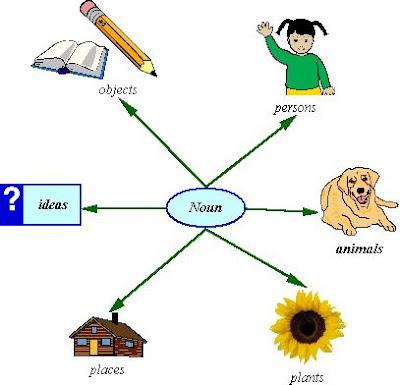
Noun
Content word that can be used to refer to a person, place, thing, quality, or action
 
Common NounsThese are words that are used to refer to common and non-specific things.

Examples:  girl, boy, camera, computer, keyboard
Types of Noun

Proper Nouns:These are names of people, places, organisations businesses, schools universities etc.  They are always written with a capital letter, even if they are in the middle of a sentence.

Examples:  London, Paris, Michael, Angela, Mercedes Benz, Honda, Oxfam, King Edward VII, Cambridge University.

Abstract Nouns:

These are words used to name non-physical things. These include feelings, states of mind, concepts etc.

Examples: love, hatered, ambition, cynicism, reluctance, mathematics, sociology

Collective Nouns:

These are words that are used to describe groups of things.

Examples: platoon, class, band, cast

Note:  Some collective nouns can only be used to refer to specific groups.

Examples: herd (of cattle),  flock (of sheep),  gaggle (of geese), caravan (of camels)

Important
A singular collective noun refers to one group, but a collective noun in plural form refers to two or more groups of the same thing.
Example: herd / herds

singular:  A herd of cattle is grazing in the field.

plural:  Many herds of cattle can be seen while driving through farm lands.

Tuesday, January 11, 2011

Improve your ability to read English quickly

Improve your ability to read English quickly and accurately takes much practice. However, you do not read documents or annoying than these words and concepts that you're not interested once you know the basics of English, you can choose from a wide range of reading materials, including different methods of presentation. Here are some fun ways your reading comprehension in English skills.

World Play Games
Today, crossword puzzles and other word game fun and non-native English speakers of all ages. If you are looking for a way to improve your vocabulary and have fun at the same time, these types of puzzles can be of great help to you. If it's something that interests you, you might also consider Scrabble, word searches and other similar games.
Take a speed reading course
If you're not interested in word games, you might want to try a speed reading course. These classes teach you how to select keywords on a point and understand the message without reading every word for word of the sentence. That said, if you have trouble isolating the nouns and verbs, you need more practice before attempting to take these courses.
Improve your ability to read English quickly

Make notes about topics that interest you
If you read a book about a topic you love, taking notes. These samples can be literally in the text or you can try to place items in your own words. If you write, you also have the opportunity to reflect on the structure of sentences and see how ideas are transmitted. This will help you learn to address these issues in a way that seems more natural.

Select materials will challenge you

Like exercise, you should constantly new goals for yourself so you can continue to grow and improve. For example, if you work your way through the book page of 100 children, it's time to start a book or on a more difficult issue to address. No matter what topics you are most interested, you'll be able to understand books that are harder to find than others. By applying to those who are harder, then you more fluency in English.

Several authors reading material
Given the number of people who have Web sites, it is easy for a wide range of styles of writing in English to enjoy. This will help you learn more about the flexibility of English, and ways of expression that most people are comfortable with. If you already know a lot about a particular subject in your own language, you can use this context to help you read English sites that focus on similar concepts.

Spend time reading materials
For the most part, once you know the basics of the language, practice their English and time is your most valuable professors. It is important to spend time reading materials that interest you in as many forms as possible and spice up your practice with things like word games and reading speed classes. Over time - and with much work - you'll see a dramatic improvement in your understanding of written English

Monday, January 10, 2011

Interview technique

In the absence of interviews are fairly predictable, there is no magic formula you can follow. However, if you plan and prepare carefully, your chances of getting the job will be. The information provided here is intended to help all job seekers.
What will you be interviewed? It is essential that you have a clear idea of what the work entails. Read the announcement. Look at the demands of the job itself. How is the work described? Do you? Look at what the job requirements and what other things are implied. Do you have the qualifications and experience? Are you overqualified? The training given? There may have qualifications or experience needed, or you may be able to make a case for lack of qualifications to be offset by related work experience or vice versa.
Interview technique

Once you've decided to take the job, do everything you can about the organization and the request. You may need advice on this, if you can not make your own. Making the right choice at this stage can mean the difference between his invited for an interview and a quick death. Keep a copy of the original offer and your application, allowing you to refresh your memory before the interview.

Work on your strengths and weaknesses:

Work on your strengths and weaknesses before the request. Strengths and weaknesses must be assessed in light of the demands of your job or career choice. If you have not thought about everything and you're not really qualified or experienced enough for the items you need, your morale will crash later with the rejection letters. You need a good understanding of your points higher than in any business. You should also consider your potential weaknesses. Be realistic - no one expects you to be perfect, but balance is essential. There may be ways to make your weak points in a positive light, if you do not seem too intelligent or arrogant.

Technical Interview:
A good interviewer will treat you politely, will ensure that you will be free from interruptions and noise, and you have been at ease before the interview starts. Often you will be asked about your trip or the time at first.

A good interviewer you test through his questions to see if you are able to do the work, and will also provide information about the work. It is important to society that even if you do not like the job, you should not leave the interview feeling of injustice. You have to listen while they talk, stay alert and giving reaction when you ask if you have something to add if you are not sure to continue talking.

Once the call begins, the interviewer can begin to tell you more about the work and society, or you can ask questions first and then you have the details of what the job entails giving. The interviewer will probably take notes, do not be discouraged by this. Most interviewers a few memories of the things you have said that they later recall all the facts and make informed decisions about which candidate to appoint. It is in your interest that they write rather than to forget you. Do not make the mistake of trying to see what the interviewer wrote, it probably will not help you and destroy your concentration on what you say.

The questions themselves may be asked a variety of ways. A good researcher would link the issues and the conversation will flow as one question leads naturally to another. Most interviewers will try to ask all candidates the same kind of issues so they have a basis of comparison, while the flexibility to probe possible weaknesses.

Make a good impression
Researchers often evaluate people very quickly when she entered the room. Typically, they analyzed the candidate in about four minutes, which means that your first four minutes are very important. However, it is possible to redeem yourself - the last minute and how to deviate from the interview are also very important. The memories of first impressions and last impressions count. So try your weak points until the middle of the interview.

The researcher will have to see what kind of person you are and where you fit into the organization is happy there. You'll show them what kind of person you are with each answer you give to each question. Your preferences may reveal your motivation as well. Although you may think you are lucky not to the interviewer, remember that if you're lucky, you will not interrupt others and will probably continue with the company longer. Nobody wants to hire someone who is always miserable or groan.

Friday, January 7, 2011

Success Interview Positive Reply

Interview - Positivity is the answer
You prepare yourself for a job interview in English? Would you like a number of questions you may be asked and possible responses appropriate know?
We show you below a series of questions and answers (in English), which argues that the solution for adequate maintenance of positivity.In today's market, a strong candidate if you're facing a fierce competition to say the right things can mean winning or losing that dream job. 
Success Interview Positive Reply

Q: Why do you want this job?
Be honest with yourself: Are you interested in what the position entails? Or is it just an impressive increase in salary? You should know exactly what's expected of you. Do you have a job? Have you looked at the website of the company? One answer might be recommended: "I am convinced that the role best suited for my career aspirations and current skills.

Q: Why should I hire you?
This question is about selling yourself. Try to emphasize your strengths, using examples of work you have done all the requirements for this role. You might say something like: "I think the job description that I could bring many skills to the organization.

Q: What is your greatest weakness?
This is called a negative question that interviewers use to your ability to keep your head cool test. Let's be honest: we all have weaknesses. But you must try your weaknesses into something positive. One possible answer might be: "I think time management is something that I could work, but I'm better the priority." Prevent a "perfectionist" or say things like: "I have no weaknesses that I know. This makes you seem arrogant and presumptuous.

Q: Why are you leaving your current role?
Always remain positive when discussing the reasons for your departure. You should have a structured answer to this question for an interview. Simply stating that a "new challenge" will or "environmental changes" can sometimes send warnings to employers because they are worried about hiring a job hopper who are constantly looking for something harder. Be honest, yet professional. No employer wants to hire you as negative about previous employers and you will immediately be considered unprofessional.

Q: Tell us something about yourself?

This is not a chance to tell the interviewer your life story. When interviewers ask this question, they are more interested to know what you like about your career and as a person and how you would fit into the corporate culture. A good answer to this might be something like: "I enjoy meeting new people and enjoy involvement in the management of projects and events.

Q: Where will you be in five years?
Unfortunately, many people are generally not prepared for this, and few of them know what they want in five years. "One suggested answer might be:" I would think that I work for a successful organization of this kind, but in a role with more responsibilities ", or" Whatever I do, I want the best of my ability. "It is how you react instead of what you say is most important here.
Finally, remember that the interview is a two way process, so it is important to a list of questions you can ask your partner to finish. These could include asking the interviewer what motivated him to join the organization, or if they have doubts about your skills / experiences on this point.
Remember that an interview should not be a difficult process if you are well prepared and I know exactly why you go for the role. The key to a successful interview is positive.

Wednesday, January 5, 2011

Increase your TOEFL scores

TOEFL Vocabulary audio learn
Learn Editors Audio | MP3 192 kbps | 247 MB
Improving your spelling. A better understanding of the syntax. Increase your TOEFL scores. Learn Audio includes more than 500 words that frequently appear on the TOEFL exam, making it your indispensable study guide when it comes to TOEFL vocabulary. Main topics: spelling sentence syntax and pronunciation more! With its convenient format, namely audio fits your active lifestyle, allowing you to study anywhere, anytime. Best of all, you'll significantly increase learning and retention with proven study format audio learn.
Increase your TOEFL scores

Download Rapidshare:
http://rapidshare.com/files/331190089/TOEFLVocabularyAudioLearn.part1.rar
http://rapidshare.com/files/331193832/TOEFLVocabularyAudioLearn.part2.rar
http://rapidshare.com/files/331190037/TOEFLVocabularyAudioLearn.part3.rar
Download:
http://uploading.com/files/3em1d193/TOEFLVocabularyAudioLearn.part1.rar/
http://uploading.com/files/1219895m/TOEFLVocabularyAudioLearn.part2.rar/
http://uploading.com/files/acbbc964/TOEFLVocabularyAudioLearn.part3.rar

Software to learn English

Exciting new software to learn English is now available. If you are one of the many people who work to learn English as a second language or third, you are probably interested in new methods of learning languages. With the advanced technology of today, just as you rely solely on books on tape or go to class, but you can take advantage of this new technology.
Although there is some controversy surrounding the use of software to learn English, many found it a valuable tool. So whatever your age or ethnicity, it's never too late or too early to learn to speak English. Whether you choose a software or any other form of language learning, no doubt you will find it exciting and worthwhile.
Software to learn English
 
Advantages and Disadvantages of using software to learn English
 
As with most styles of learning English, there are advantages and disadvantages to using software to learn English. Take a look at the advantages and disadvantages of using this software to decide whether the software is really a good choice for your specific needs.

Advantages:
Learn at your own pace - a pro using the software to learn English is that you can learn the language in your own time. There will be no need to worry about fitting classes into your schedule and you can learn at a pace that suits you best.
Continuous operation - Once you have the software to learn English, you can continue, even after mastering the basics. The software can still be used to improve your English by practicing or maintaining your skills at their best.

Disadvantages:
Not so many real interaction - On the other hand, a cunt use this software for learning English is not much interaction with real software. In one class, your English with others, but with software, human interaction is missing.
The price can be costly - Another idiot who can not allow people to use software as a method of learning English is that the price may be a bit pricey. Some software can cost over $ 250, which is quite a bit of money to pay for software.

Tips to remember when buying software for learning English
 
If you decide to go with software for learning English, no doubt you want to get the best software available. The following are some tips to help you make the best choice of software.

Tip # 1 - Compare prices - Using this software to buy, make sure you take the time to compare prices. You want the best deal by comparing prices of the same software in multiple locations can help you save money.

Tip # 2 - Read Comment- Comment on the playback software can be useful as well and can get an idea of the best software options available to give. Discover the advantages and disadvantages of each software, choose one that seems to have the best ratings.

Tip # 3 - Compare Features - Take a look at the features of both when it comes to choosing a software package. Want as many functions as possible to help you learn better English.

Selection of software for learning English Soon

So if you really consider a software program to learn English, the following are some of the best software choices to consider.

Tell Me More Premium - This software is expensive, about $ 300, but it comes with many features and useful tools for learning. You start by learning the fundamentals of vocabulary and simple English. If you go, your skills will be built with writing, reading, pronunciation exercises, and even listening comprehension exercises.

Learn English Now - A cheaper alternative when it comes to software for learning English is learning English now. You only pay $ 42 for this software, a great value. It offers the ideal education for all levels of students in basic English, but he taught only in Spanish and English.

English Lab - This software will cost just under $ 65 and it has much to offer for the price. You get a glimpse of the English language and many exercises, such as filling the void and audio exercises are included. If it can not so thoroughly course it will definitely help you with grammar, vocabulary and pronunciation.

With all these different options of software to learn English, you will be on your way to power soon.

Monday, January 3, 2011

Step's to find a job

Finding a job is a horrible experience for most people in the world. There is nothing worse than to wake up in the morning and go "job search", somehow even the worst job / s you have already taken such as "search the job better than that. It is worse when you open the mailbox, and bills piling up, for reasons still send bills always seems to work. It is certain things you can do to make life a little easier. The first is to make sure that you trust. I know that it is easy to say, and almost impossible to do, but it is always important. Here are a few to help find a job.
Step's to find a job

1.Set hours - to set an exact date for hours that you work for "job application" It seems so simple, even stupid, but you'll be surprised how often we are ensuring interferes. home, cleaning, meetings, helping friends, etc. It is not unusual when you think they are unemployed, "on vacation" feeling, and may think that you are available "to start from."
Tell everyone that you do not mind if tp "work" and that "job search" time to spend. If possible, try to be as close as possible "job search" as possible as you would if you were at work. If you're used to working 8 hours a day, then spend 8 hours a day to look for work, and make tea and coffee breaks, and eating

 2.Resumes - Please re-enter, and is constantly looking for ways to improve your CV. Do not think that just because "professional" to write a CV, "it can not be improved or changed. Do not let people zelf" professionals "to tell you that there is only one way to continue writing. There are a few different basic forms of recovery, but there are many" means "to rewrite the job.

Modify your resume - If you do not get a good answer to continue you have sent, it is time to consider or amend your CV.

Guest CV - Ask the people in your CV, forums and newsgroups are a good place to note again to receive feedback. Be sure to remove your personal information.

The Internet has 100 sites, how to improve your CV. Custom write your resume to meet the requirements of each contract, if possible, of course, and writes a good letter.

3.Business cards - are a necessity, because you are unemployed does not mean you do not have work and want to present yourself as a professional at all times. If you have a little money, no worries. Create a series of cards myself. Purchase special paper, you can print cards on paper cut.
There are many different business card templates you can download, and a little more or less complete data, and print. It's as simple as it sounds, and if you do not have a printer, then ask a friend or try your local library.

4.Improving your skills - If you feel or if you have "free time", try your skills, the Internet is a great way to start doing, if seized, more powerful computers, learn new ideas, updating information, etc.

5.Contact Building - If you are looking for work. Find your former classmates, people you went to school, military unit or other group of people to common ground.
Does not start, I'm looking for a job, but the time to really learn and friendship, because that way they will be more inclined to help you develop.

6. Forum - Join the message boards and discussion groups, get active is a great way for people who can give advice or even give you a job to know.

7.Be Friendly - to participate in local events that are free of course. Out of volunteers and talk to people, say hello, and tell them how you are looking for work and give them a copy of the card, so they can get back to you. Get to know people who live in their neighborhood stores to know (if such a thing where you live)

8.Fax/E-Mail - Send faxes and emails from the world's people and places and places do not have a job, you never know who is the work of the future. It does not cost money or if the fax does not have much money, and it is a good way places looking for a job

Thursday, December 30, 2010

Vowel a,e,i,o,u

Vowel is a sort of sound which no closing of the throat or mouth occurs anytime vocalization. The vowels can be contrasted with the consonants, the sounds which one or more points where the air is stopped. In almost all languages, the words contain at least one vowel. If one word can be formed without consonants - such as English or the words I mean - no password may consist of consonants without a vowel.
Vowel a,e,i,o,u

Vowels in many languages are not essential in the general sense. On the contrary, a vowel in the following languages - many of which are Semitic languages - acts more to give a bow to the word to distinguish that other individual words. A parallel to this in English can be seen in the example of diving and dove and lay and lie, where the base word is the same but the vowel change means tense. Languages that this type of structure are often not even make all their vowels in written text. Arabic and Hebrew are good examples of this, when marking a lot of vowels is not required in writing.


Since a vowel refers to a type of sound, the spelling of the letters stand for a consonant in certain circumstances, a vowel in others. In English, we see the letters Y and W are most often used for consonants, but can also be used to represent vowels. In the case of y, for example, can you compare its use in there, words per day. In the word there, it acts as a single consonant with the center of the tongue blocks the air flow on one side touching the palette of the mouth - this is called a palatal approximant. In the word day, on the other hand, is formed as a vowel when the word was written in English as dei.

In the case of w, we can examine the words and how to woo. In the word woo the letter serves as a consonant, with the back of the tongue blocks the air flow on one side touching the palette of the mouth - called approximate labiovelar. In case the word as a vowel, which can be represented by like hao written English.

In English, there are five letters still a vowel when it is written: a, e, i, o, u. These five letters and accounts for more than five vowels, however, as the word, or in combination with other vowels. Compare the letter in the words hat and hate as one of many examples.

Tuesday, December 21, 2010

Importance of English

English is very necessary  because it affects the potential both personally and professionally. Because learning english is to increase your knowledge of the culture and problems, it will enhance business and professional options as well as personal opportunities. Overview of learning English culture, politics, business practices and emerging trends in the global community.

Personal Compensation

Learning English is an interesting and exciting. Challenges are to learn to think in new ways as the recognition that most cherished values may differ from the values of others. Learning to appreciate the different values than yours is one of the most rewarding aspects of learning English, because your level of understanding of yourself. Learning English is interesting, because you develop language skills, you can meet new people who seem different foods, movies and entertainment.

Expertise
Learning to read in English opens the door for many more resources than you would have access to the language alone. Apart from books, magazines, newspapers, professional printed in English only 75% of webpages are written in English. Reading a variety of resources offer a wide range of subjects you know and deepen their knowledge. Once you have access to this resource for many others, you get more than those who have limited resources.

Pleasure for traveling

English is the official language in 52 countries and is the main language of many small colonies and territories. It is estimated that nearly one third of the world's population speaks and understands English, at least a beginner-intermediate. In addition, English is the de facto language of diplomacy. If you are learning English, the world available to you. Whether you are traveling for pleasure or business opportunities, learning English, could be easier. Benefits of Travel is to give you the benefit of international affairs, particularly in business.
Importance of English
Working  place
As English is the language of the acts of diplomacy, it is also the de facto language of business. Ability to read, write and communicate in English opens up opportunities to lock in business. Companies need English qualified individuals to create and manage foreign subsidiaries, to communicate with competitors in other countries, to monitor developments in the field and act as a monitor translators, negotiators, links, and consultants of the company both at home and abroad.

Greater diversity

Learning English, you can experience different cultures and different people. If your sense of diversity to expand, we become more tolerant towards differences between people. This increases the bargaining table and problem solving skills that are useful both personally and professionally. In today's global economy, in which diversity is essential to the success of both home and abroad.

Steps your working meeting more organized

In your life, by organizing and participating in business meetings is almost inevitable. unproductive meetings, but often leads to waste of resources, time and money.
Most professionals do not recognize that the success of the meetings too much skill and expertise. A little reflection, people can work more effectively and to hold meetings at the best possible results. Below are five tips to help you to reach all business meetings in advance.
Tips business meeting more perfect
  1. First, prepare in advance their agenda. Describe all important questions and problems have been addressed. In selecting the title, so the impact on the future productivity of all members attending the meeting. Also assign a fixed amount of time per subject. Agenda of the well-organized to keep you on track.
  2. Participation in organized industry, your time value. Make sure that everyone present at the time. The duration of your meeting a significant impact on productivity. So keep your meetings short and focused, so nobody loses focus. If necessary you can also share the agenda of two separate sessions to effectively manage time.
  3. Then the leader must encourage all members. In discussing ideas, making sure that everyone is equally express their opinions. Also questions and receive feedback from. Although the arguments are standard business meetings, just to make sure they are correct. Use the cord to ensure that your meeting is progressing normally.
  4. Using the Mind Mapping task tracking software is a great way to get the most business meetings. This software is unique in that creativity can take notes during the meeting and a powerful business presentations in the meetings. Mind Mapper allows you to quickly take notes, without losing focus. Moreover, it also allows for future additions without any trouble.
  5. Finally, at the end of your meeting, make sure all necessary materials are thoroughly discussed and goals. Keep all decisions of the time. Summary of the meeting places of interest and importance to all participating members of what has been jointly decided to remember.

Wednesday, September 22, 2010

English Grammar Principle

Procedure of English Grammar, English Grammar Principle
Even despite the fact that most of us either flunked out or fell napping during English grammar class in school, it is an essential part of writing whether you are a professional writer or just want to write a note to your son’s teacher. Using good grammar helps get your point across efficiently and focuses the attention on what you have to say in its place of how you choose to say it. While there are hundreds of rules of grammar that are laid out in several approach guides such as The Chicago Manual of Style and The Elements of Style, there are some that are absolute essentials to good writing that everyone should master.
1. Harmony – Agreement in a sentence refers to all of the parts of the sentence agree with with each other. For example, you wouldn’t say “Maria Robert has two pieces of toast and I have three.” You would instead say, “John has two pieces of toast and I have three.” The subjects and verbs need to be in agreement. Without sentence agreement you have all-out civil war in your sentence and no one knows what is going on. If your sentence parts don’t agree with each other you will have to jump in and mediate, causing hard feelings all around.
2. Tense – Tense refers to time. What time is it in your sentence? Whatever time it is it should remain consistent throughout your whole piece of writing. If it was last week you are talking about, stay there. There are three tenses in writing, past tense, present tense and future tense. Here is an example of writing with mixed tenses: “Carrie wondered how she is going to finish in time, but Joe will help her.” This sentence contains all three tenses, past in “wondered”, present in “is” and future in “will”. Pick a tense and stick to it! The sentence could read “Carry wonders how she will finish in time, but Joe will help.”
3. Spelling – One of the most important things, and without it, you can kiss your credibility goodbye. Spell checkers are poor substitutes for knowing how to spell and can move and can leave behind more errors than you realize. There are many different forms of words and your spell checker does not know which form you wanted to use. For example, “When Mark washed they’re care, he forgot too putt on the wax.”
English Grammar Principle
 
4. Run-On Sentences – A run-on sentence is one that is just too darned long! Not only is it too long, it is incorrect. Usually, a run-on sentence can be made into two or more sentences with a little punctuation and style. An example of a run-on sentence might be: “We walked over to the commissary to get something to eat but it was closed so we didn’t know what to do so we kept walking until we saw a restaurant and decided to go in and get something to eat but Andrew didn’t want to eat there so we kept going for another mile.” This sentence could have gone on for another mile too! Break up the sentence into smaller, more coherent parts.
5. Punctuation – It is very important to know your punctuation, even if you never plan on using a semicolon for the rest of your life. The most important thing to learn is where to put your commas, a common mistake among writers. Commas are used to separate parts of sentences that stand alone, such as those that are parenthetical. For example “There were too many flowers, not that I minded, but they took up most of the room.” Avoid using commas after conjunctions like“but” and “and.” Semi-colons and colons take up an entire chapter, read about them in your style book.
6. Usage – If you are going to use a word , you really ought to know how to use it. Some writers think big words look impressive but actually the reverse is true if the word is used incorrectly. Words don’t have to be big to be misused, consider its vs. it’s.
7. Capitalization – Words at the beginning of sentences aren’t the only ones worthy of capital letters. Always capitalize proper names such as people and places. Titles of all kinds deserve capital letters and so do acronyms.
8. Point of View – The point of view refers to whoever is telling the story or “speaking.” When you write a letter you are writing in “first person” which includes I, me, my, we and our. Second person writing occurs when we talk about you and yours and third person includes he, she, they and theirs. In third person writing, the author does not interject himself into the story.
9. Sentence Fragments – A sentence is an fragment is an incomplete sentence that does not include both noun and verb. An example of a sentence fragment might be, “Really dumb.” Make sure your sentences reflect a complete thought unless you are writing dialog.
10. Wasted Words – A big no-no. Sometimes we throw in words just to round out our sentences, or we over-describe something, like, “The really ugly puke-green dress was hanging on the wall.” Do we really need to point out that a puke-green dress was really ugly? Economize your words and you will have fewer chances for grammatical errors.

Tuesday, September 7, 2010

Basic Skills Mandatory For Thesis Writing

Basic Skills Mandatory For Thesis Writing? Thesis Tips Writing
Thesis writing appear very difficult to some student; they think that they can not write. Despite the fact that they are very well-informed and smart, they are not able to write a piece of their own.
To some area it is true that writing is not everybody’s cup of tea but if a person is keen to learn, nothing is impossible in this world.If a person is consistent in his aims and goals he can rule the world; he can make impossible things possible. Same is the case with thesis writing; it needs hardworking and practice; the more you write the more your writing style and language will be polished and within a short span of time you will be included among those who are called the best essay writers.
Basic Skill for Thesis writing


Certain Skills Required for Thesis Writing.
First of all you need to analyze the title or topic of the thesis on which you are asked to write article. Once you completely understand what the title says next step is to collect information and facts using various source like print or electronic source. After gathering information you need to highlight the most important and less important things in order to prioritize your task. After that, comes the writing process; once you start writing there are few things which should be kept in mind.
First you should not try to overwhelm your thesis with difficult words, lengthy sentences and stylish writing style. Always remember, your essay should be written in such a way that it can be understandable to every person; difficult words and lengthy sentences may lose readers’ attention.
A writer should know his readers; according to the comprehension level of reader a writer should create his piece of writing. If you are writing for children, the language should be simple and easy but if it is for intellectuals the language can avoid simplicity.

Sunday, August 29, 2010

Different Ways to Educating Your English Reading Comprehension

5 Ways to Educating Your English Reading Comprehension
Civilizing your capability to read English quickly and precisely takes a great deal of put into practice. However, you don’t have to read uninteresting materials that or ones that contain words and concepts you aren’t interested in. Once you know the basic fundamentals of the English language, you can select from a wide variety of reading resources, including different methods of presentation. Here are a few fun ways to improve your English reading comprehension.
Amuse Yourself Expression 
Today, crossword puzzles and other types of word game mystery entertain native and non-native English speakers of all ages. If you’re looking for a way to improve your vocabulary and have fun at the same time, these types of puzzles can be of immense help to you. If this is something that interests you, you might also consider Scrabble, word searches and other similar games.
TAKE A SPEED READING LESSONS
If you aren’t interested in word games, you might want to try taking a course in speed reading. These lessons will teach you how to picks key words out of paragraph and understand the message without having to read each sentence word for word. That said, if you’re having difficulty isolating nouns and verbs, you may need to practice more before you try taking these courses.
English Reading Comprehension
TAKE OBSERVATIONS ON SUBJECTS THAT AWARENESS
If you’re reading a book on topic that you enjoy, take some notes. These can be verbatim samples from the text or you can try putting section in your own words. As you write, you’ll also have an opportunity to think about the sentence structures and see how ideas are conveyed. This will help you learn to discuss these topics in a way that sounds more natural.
CHOOSE RESOURCES THAT WILL CONFRONT YOU
Just like with physical exercise, you need to constantly set new goals or yourself so that you continue to progress and improve. For example, if you’re able to work your way through a 100 page children’s book, it’s time to start tackling a longer book or one on a more difficult topic. Regardless of which subjects interest you the most, you’ll be able to find some books that are harder to comprehend than others. By applying yourself  to the ones that are more difficult, you’ll gain increased mastery over written English.
INTERPRET MATERIALS FROM MANY DIFFERENT AUTHORS
Considering the number of people that have websites, it’s easy to sample a wide range of English writing styles. This will help you learn about the flexibility of the English language, as well as the means of expression that most people are comfortable with. If you already know a great deal about a certain topic in your native language, you can use that background to help you read websites in English that focus on similar concepts.
For the most part, once you know the basic elements of the English language, practice and time will be your most valuable teachers. It’s important to spend time reading materials that interest you in as many forms as possible and to spice up your practice with things like word games and speed reading classes. Over time – and with hard work – you’ll see dramatic improvements in your comprehension of written English.


Wednesday, August 25, 2010

CAFE ENGLISH 1.0-ENGLISH LEARNING SOFTWARE

Cafe English 1.0 is the world's biggest and best spoken English learning software. This huge software has 40 chapters spread in 6 CDs.
cafe English 1.0

Each chapter focuses on a specific part of your daily life. Rich multimedia content with tons of audio and video to give you lots of listening and speaking practice. Multiple exercise types to keep you engrossed in learning. Talk to on-screen virtual characters through your headphone-mic and build up your fluency quickly.

CAFE ENGLISH 1.0 DOWNLOAD

Friday, July 30, 2010

Writing a resume in English

Writing a resume in English
Significant  Points When Writing a resume in English
The purpose of an English CV is to sell yourself :
An English CV is seen as an an opportunity to sell yourself and should emphasis your skills, experiences and achievements. You should include successes and wherever possible include facts and figures to support your claims. Do NOT include information that is negative.
Spelling and Grammar Check :
Correct spelling and grammar are of absolute importance in an English CV. Employers will NOT tolerate any mistakes. It is very important that a native English speaker checks your CV before you send it to an English-speaking employer.
Do not include a photo:
Most English employers do NOT like to see a photo on the CV and, in fact, including one could work against you. Only include a photo if it has been specifically requested for a particular job application.
English Language skills:
This is a very important aspect of your CV and your professional career. You must explain your knowledge knowledge of the English language under the ‘Skills’ heading. Describe your level of knowledge as one of the following
Bilingual  -- You can speak English as well as your mother tongue
Fluent      -- You have a complete working knowledge of the English language, both written and speaking.
Working knowledge--You have a good practical knowledge of  English for professional purposes.
Conversational--You can converse adequately in English with good comprehension.
Writing a resume in English
English CV Format :
Your name, address, telephone number and email address should appear at the top of your English CV. Always  use a capital letter at the beginning of a name including the name of a street,town or country. Do NOT put CV or Curriculum Vitae as a heading.
Your CV should be produced on a word processor, not hand written, and be available softcopy as a Word or PDF file. If you are printing your CV you should use good quality paper.
An employer will scan your CV in thirty seconds looking for keywords that are relevant to the vacancy he is trying to fill. Keep your CV short and concise so that your positive attributes stand out. Your CV should be no more than two pages long.
Do NOT use initials for company names or qualifications, as these could be meaningless to an English employer. Always write the words in full.
Headings :1. Profile: This is an opportunity to summarise the skills and experience you have described elsewhere in your CV. It is the first part of the CV that the employer will read. It should be only one or two paragraphs long otherwise the reader may not go on to read the rest of your CV. You should also include your career aspirations.
2. Achievements: list any special achievements from your career history or education that may make you stand out from other candidates . List no more than six.
3. Career History: This is a very important part of your CV. The most common CV format is written in reverse-chronological order. Start with your most recent employment and work backwards. List the dates between which you worked for each employer; the name of the employer, your position and the location at which you worked. Write a short description of the company and then describe your responsibilities including facts and figures as much as possible.
4. Skills: In an English CV it is necessary to list particular technical, professional or other skills separate from your career history. An English employer will not necessarily be familiar with non-English professional qualifications therefore you must explain each one.
5. Education: You must enter your highest qualification first, then where achieved, and then dates. Make sure you explain any non-English qualifications or try and put the English equivalent, e.g. Baccalaureate, French equivalent to the Higher Leaving Certificate and A levels. Do not include grades unless they are particularly impressive.
6. Personal details: It is not necessary to include all of your personal details on an English CV as your skills and experience are of paramount importance. However, you need to include your nationality and it is normal to include your Date of Birth such as: 11th November 1967. Do not put your age.
7. Interests. You do not have to include your interest on an English CV but they will help to give the employer a rounded picture of you as an individual.
Signature: It is not necessary to personally sign your English CV.

Wednesday, July 28, 2010

Active & Passive Verb Forms

Active / Passive Verb Forms
Sentences can be active or passive. Therefore, tenses also have "Active forms" and "Passive forms." You must learn to recognize the difference to successfully speak English.
Active Form
In active sentences, the thing doing the action is the subject of the sentence and the thing receiving the action is the object. Most sentences are active.
[Thing doing action] + [verb] + [thing receiving action]
Examples:
  Teacher           teaches          the students
(subject doing action)        (verb)                    (object receiving action)   

Passive Form
In passive sentences,the thing receiving the action is the subject of the sentence and the thing doing the action is optionally included near the end of the sentence. You can use the passive form if you think that the thing receiving the action is more important or should be emphasized. You can also use the passive form if you do not know who is doing the action or if you do not want to mention who is doing the action.
[Thing receiving action] + [be] + [past participle of verb] + [by] + [thing doing action]
 
Examples:
The Student          are taught         by the Professor.
 (subject receiving action)        ( passive verb)                    (doing action)   

Active and passive verb
Active / Passive Overview
Simple Present          Once a week, Raina cleans the house.(Active)
Simple Present          Once a week, the house is cleaned by Raina.(Passive)
Present Continuous   Right now, Sarah is writing the letter. (Active)
Present Continuous   Right now, the letter is being written by Sarah.(Passive)
Simple Past                Sam repaired the car (Active)
Simple Past                The car was repaired by Sam.(Passive)
 Present Perfect         Many tourists have visited that castle.(Active)  
Present Perfect         That castle has been visited by many tourists. .(Passive) 
Present Perfect Continuous    Recently, John has been doing the work(Active)  
Present Perfect Continuous    Recently, the work has been being done by John.(Passive)

Verb Tense Class

Verb Tense Class
Verb tenses are tools that English speakers use to express time in their language. You may find that many English tenses do not have direct translations in your language. That is not a problem. By studying this verb tense class, you will learn to think like a native English speaker. If you prefer to use the verb tense pages as a reference only and do not want to complete the tutorial
Types of Verbs
Before you begin the verb tense lessons, it is extremely important to understand that NOT all English verbs are the same. English verbs are divided into three groups: Normal Verbs, Non-Continuous Verbs, and Mixed Verbs.
Group I Normal Verbs
Most verbs are "Normal Verbs." These verbs are usually physical actions which you can see somebody doing. These verbs can be used in all tenses.
Normal Verbs
To run, to walk, to eat, to fly, to go, to say, to touch, etc.
Examples:
•I eat dinner every day.
•I am eating dinner now. 
Verb Tense Class

Group II Non-Continuous Verbs
The second group, called "Non-Continuous Verbs," is smaller. These verbs are usually things you cannot see somebody doing. These verbs are rarely used in continuous tenses. They include:
Abstract Verbs
To be, to want, to cost, to seem, to need, to care, to contain, to owe, to exist.
Possession Verbs
To possess, to own, to belong.
Emotion Verb
To like, to love, to hate, to dislike, to fear, to envy, to mind...
Examples:
•    He is needing help now. Not Correct
•    He needs help now. Correct
•    He is wanting a drink now. Not Correct
•    He wants a drink now. Correct 
Group III Mixed Verbs
The third group, called "Mixed Verbs," is the smallest group. These verbs have more than one meaning. In a way, each meaning is unique verb. Some meanings behave like "Non-Continuous Verbs," while other meanings behave like "Normal Verbs."
Mixed Verbs 
To appear, to feel, to have, to hear, to look, to see, to weigh..

Saturday, July 24, 2010

Choose a Good Dictionary about Vocabulary

Expanding your vocabulary
To develop one’s vocabulary is not as difficult as you first believe. A number of straightforward activities can facilitate familiarisation and understanding. Many strategies for learning vocabulary are also present in software products, such as those developed by Ultimate Vocabulary.
Expanding your vocabulary is no easy task. But you can make headway if you learn how to use a dictionary properly.
Let's say you have just read or heard a word unfamiliar to you. How do you use a dictionary to help you remember the new word?
Choose a Good Dictionary
In expanding your vocabulary, you first need a good dictionary. For Australian English, try the Macquarie Dictionary. For British English, try the Oxford English Dictionary. For US English, try Websters. Keep the dictionary close by, consult it carefully and often.
How NOT to Use the Dictionary
Most of us dictionaries unproductively. Assume you look up your dictionary for the meaning of a word. Of the various definitions the dictionary gives, you disregard all of them except the definition that makes sense of the word in the context in which you heard it or saw it, or which fits your preconception of the word's meaning. As the authors of The Century Vocabulary Builder say, "At best you have tided over a transitory need, or have verified a surmise." You have not really learned the word; you have not "so fixed it in memory that henceforth, night or day, you can take it up like a familiar tool. "Fixing a word in memory" involves effort and application. You must use a dictionary intelligently.
Choose Good Dictionary about Vocabulary

The Secret to Using a Dictionary
A big secret to using a dictionary to expand your vocabulary is finding the original meaning of the word. If the word comes from Old English or from a foreign language, look at the word's origin. You will find this information (called etymology) inside brackets or parentheses following the word or at the end of the list of definitions. For example, you may find the Latin, Greek, French, German, Italian, or other word that your word came from.
Having found your word's original meaning, get this original meaning into your head; the original meaning is one of the really significant things about the word and really helps in expanding your vocabulary.
Next,find the modern mea find the modern meaning of the word. Look through the modern definitions. Your word might have too many definitions, or the differences between the meanings might be too subtle, for you to keep all the meanings clearly in mind. But do not worry about this. Consider those different meanings, but focus mainly on the drift or the central meaning of the word.
You now know the original meaning of the word and its central meaning today. The two meanings might be the same or they might be completely different. But you should be able to see some sort of connection between the two meanings. When you have done this, you have mastered the word. From the two meanings you can work out the other meanings, wherever and whenever you find them, since the other meanings are just outgrowths and applications of the original meaning and the modern meaning. By using a dictionary in this way, you will expand your vocabulary.
Modern vocabulary-expanding tools
Similar ideas underlie modern vocabulary-expanding tools. For example, Ultimate Vocabulary hooks into online etymology databases, making it easy for you to see the original meaning and origin of a word. Ultimate Vocabulary also has a comprehensive dictionary that uses Princeton University's "WordNet" database for the software's backend.
Are you having difficulty learning English? Are you saying to yourself "If only I could learn English better, I could do so much more."? If you are answering yes to these questions, I'm sure you're wondering how you can do that. In this article, I would like to explain some problems many English learners face, and ways to improve your English that are simple and can be fun at the same time